It’s been twenty-four hours of striking, driving, unpacking, cleaning and bathing. The revelation of Burning Man has burrowed deep in my spleen, releasing spiritual spores infecting every cognitive joint I once so carefully constructed. I doubt I will ever be the same again.
Thank you in advance to all the people and sites supplying the pictures for this perspective. It’s hard to believe that a week ago we drove to Reno under pastry-shaped clouds. We spent Sunday night there, holed up at the Sands, buying water and gathering our strength for the week ahead. Gilded signs and deteriorating casinos created a tinfoil illusion over the timeless race to find meaning in easy-won money. Lonely-hearted wanderers were on their last legs, those who could not be bothered with Vegas, crouched under smoke and craps and one-arm bandits wrapped in the glittered refuse of Americana.
Still, Reno was filled with honest, hardworking people, waiters, hostesses, clerks who witnessed the yearly migration of freaks through their gilded paradise into the deep Nevada desert. Who knows how they viewed us, counterculture hoodlums strutting about, greasy with crazed anticipation to go squat in some alien mind state. As I wolfed down the last vegetables that would fortify me for a week, my friend Sitari and I wondered if citizens of Reno imagined life out on the playa. Perhaps it was similar to how I wondered about it myself. After all, the anticipation of my virgin Burn was possessed with a jittery poltergeist of the unknown. I had managed to subdue my expectations, but not my hope.
We arrived in Black Rock City Monday as the sun climbed past its apex. Locating our camp, the Bouncy Bouncy Club off the 4:30 keyhole, Sitari and I set to work constructing the BBC bar we had been planning, and as the heat dissipated in twilight, we saw her initial vision come together, a turqoise shell of protective fabric contrasting against the endless yellow-brown clay lakebed. Fireworks sprang over an Esplanade dotted with theme camps, and I was struck with a deep sense of celebration. We had made it, arrived to witness the Man burn green.
It was in those first few hours that I also met Pan. Or rather, the pagan deity’s current incarnation, a contractor from Portland named Dr. Lem. Those of you who know him know his wild hair and nappy beard and Komodo dragon tattoo crawling across his leg and up his shoulder blades, his warm heart and extroversion. More than likely you’re also familiar with his pierced penis and his penchant for playing with it. He showed me what was to become a mainstay of playa hospitality. No, not aerated genitals—though those were abundant—but a big hug, and a heartfelt “welcome home.” Yet as soon as he welcomed me, he disappeared, running across the playa looking for his dome, which had been shipped to BRC as he flew in the night before.
A towering beacon magnetized me, and I drew near the Temple for the first time, with its giant ivory crossbeams, stacked circular windows and twin arms spreading concave bellies under muted stars. Approaching closely, I saw the intricacy of woven wooden lattices climbing up screens and supporting beams, radiating Shinto purity across the playa, piercing my heart with wonder. My virgin eyes began to open to the incantation cast upon the land by Black Rock City. It was a binding creative vision that gripped my mind as a shadow began to fall across the moon. As this lunar splotch expanded, the Temple tied an invisible tether to my belly, attaching me, tracking me. Knowing I would be back, I pedaled away, one man biking across a dark mystic sea, comforted by waves of novelty in my gut, by lights blinking around the circumference of the horizon.

I went to Opulent Temple, a party space by 2:00 that sported giant circular screens sandwiching a mesh egg encapsulating the DJ booth and supporting a giant double flamethrower. Seriously. Blasts of flame scorched the sky. Progressive trance danced in thin desert air, and the vibe was filled with ecstasy euphoria and the molded meanderings of psylocibin. Burners howled wild calls in the throes of ensuing transformation, prancing and praying to aligning synchronicity as the dark shadow of the earth eclipsed the moon in maroon.
Or was it?
As the day progressed and we continued to evolve our camp as more BBCers arrived, inflating our bouncy castle and dome, and erecting our secret tunnel, the distinction blurred between acceptable individual expression and that which impinges on the health of the community. The repetitive clang of my mallet on rebar was meditative, and I could not help but play devil’s advocate with myself, questioning where the line really lay. If forced to choose, which should drive our behavior, our individualism or commitment to our community?
It was a question that haunted me as we rocked out at the Deep End, watching giant smoke rings curl up over the fat moonrise, channeling the energy of the new Burn into a serene state. But afterwards, as we listening to bagpipes and drinking Guinness at the newly opened Irish playa pub Paddy Mirage (yes, a real, two-story wooden pub), my warm, germinating illumination had grown hairline fractures. After the sun set these cracks bloomed into jagged cracking spears of uncertainty. Still, I subdued these doubts, preferring the route to fun. Tooling about the playa in Loki’s artcar “Cloud Nine,” which had the most comfortable damn cushions my ass had the pleasure of kissing over the whole week, we traveled to see Glitch Mob, incredible as always, tear apart the 4:30 keyhole. Syncopated breaks from the Space Cowboy’s platform were techno-futuristic breakbeat, generating a cloud of playa dust hazing over rhythmic joints framing melodies that popped squealing samples in creaking angles like circus contortionists slaying our brains.
Yet as danced, the questions in my head were exacerbated by a strange vibe. The vibe tasted like one related to the euphoric collectivism of my involvement in the rave scene but was flavored by a dark and frustrated egotism that I had found pervasive in the violent punk rock underground. It took me several tracks to put my finger on it, but when I did it stank of judgment, of individuals emanating condescension towards others, of those with fancier costumes or more friends bathing in elitism. This scent was very subtle, and at no time did I ever feel threatened or unwelcome, but the vibe was there, and it announced that some individuals were more important to the burn than others. As the BBCer Bebop put it, they were ‘burnier than thou.’
Now, such conceit is logical. Clearly, in the middle of a desert wasteland, self-reliance is the minimum threshold for survival, and those who drive the party, or the ritual, or construct the city from personal resources, are in fact contributing more and are more “important” to the functioning and success of both Black Rock City and the Burn in general. But the concept of importance is a slippery slope. For if the common BRC resident is undervalued, if at some level the community of people hard core enough to just be there and participate is not embraced, then for me at least, Burning Man would never achieve the evolved state of collective human illumination I had found so fulfilling in other undergrounds. Furthermore, such elitism is the source of, and only a few psychological steps (albeit large steps) removed from the arrogance and irresponsibility required for obsessed individuals like Addis to declare the superiority of their truth over the collective, and attempt to destroy the Burn by pre-empting its defining ritual. As I crashed Tuesday night it seemed that the very transcendence I had been hoping for would be illusory, and my heart was filled with doubt.
But Wednesday was a new day, and filled with adventure. Mid-morning a bunch of us BBCers biked over to the Golden Café laden with alcoholic gifts. For those of you who don’t know, The Golden Café supplies drinks to all, as it must in a gift economy; but only those who bring alcohol in quality and quantity are treated to medallions signaling the wearer as being worthy of better drinks. Well, we received those excellent medallions, but I was treated to an additional surprise. The Café was barely populated, its musicians not ready yet to take the stage, and so Bebop and I were able to borrow a guitar and base respectively, and jam out. Between work and writing and life I had forgotten the simple joy of playing music with others. The playa now gently reminded me of creative pleasures, and even though our session lasted less than an hour, I felt rejuvenated. A child-like happiness percolated up through my blood, and I felt alive, more alive than I had in many months. Elated, I itched to try my hand at the flimsy rock wall constructed across the street. Scaling it and standing upon its rickety structure, feeling a hundred feet tall, I gazed out at the massive circle of cars and tents extending back towards the airport and the black mountains beyond. I could not comprehend how many masses had migrated to the beacon of Burning Man within the last forty-eight hours. They now surrounded the alien planet of the Burn like rings of playa dust encapsulating a crystalline spirit.
Exhausted, I took a siesta to hide from peaking heat, and woke up in a different burn, an evolved era. The BBC camp itself hummed with excitement as our dome finally arrived and was inflated adjacent to the bar. Pan had returned, towing Little Orphan Annie and the towering, truck-sized Tonka. Sitari and I joined them, stocking up on booze and venturing out to Tao-surf (to cite the coined currency of Sitari) on artcars. I could never have predicted how the Burn would evolve.
As we snuck out our secret tunnel onto the keyhole and peered beyond the Esplanade, the playa had exploded in light. Where before there were sparse art installations scattered about the Temple in moonlight, now tens of thousands tromped across miles of clay, on foot lighted by glow sticks, riding bikes outfitted with el-wire, crowding art cars, and the collective neon glow outshined the full moon. The first vehicle we found was a two-story boat with mast and rigging. The five of us climbed aboard, and I watched in awe from the top deck as we sailed across the dry sea, past flaming cacti, bushes of bouncing Christmas lights, fire dancers pushing flaming flow weapons in trailing arcs, costumed bunny bikers, mirror-portals, giant bus-ships with party decks playing looped porn, glowing butterflies and ants and elephants trolling about the playa on mechanical chases, torch towers spewing gas-flames, lovers kissing on deep playa. Oh, and let’s not forget the guy who as far as I’m concerned wins the prize for the dopest costume on the playa with his bejeweled, head-to-toe armor complete with visor and lantern to light his resplendence. In the center of it all, the Man’s pavilion and the Temple were dressed in their formal symbolism. Black Rock City had hit critical mass, its residents crisscrossing each others’ paths ten thousand times per minute, making the playa light up like a giant pinball machine cranked on crystal meth. But the chaos, while wild and churning, was infused with spirituality, a conscious excavation for a buried holiness. As we hopped from the first boat to a glowing bus blasting trance, it at first seemed like the largest, most obscenely ridiculous rave I had ever witnessed, and its scale blew me away.

But as we neared Cubatron, that three-dimensional array of glowing orbs that blinked into and out of colored light, shifting patterns from rotating wheels to white snowstorms to sweeping rainbows to rotating light effigies of the Man, I started to see the burn as something like a rave but not a rave. And as we hopped to other art installations, and Tao-surfed over to Entheon Villiage to revisit epic Glitch Mob breaks and later the dark hammer of Bassnectar wrecking samples between gears of hard womp, the phylogeny of Burning Man began to clarify in my mind. Grooving to arrowheads of piercing bass, watching animated visuals twist on hexagonal cells of the giant dome, ideas began flooding my brain, inundating it with a deluge of realizations answering questions I had been struggling with for months. And one of these insights was a hypothesis on the phylogenic nature of sub-cultures.
After participating for years in various sub-cultures from the rave scene to the punk scene and several in-between, there were certain themes that seemed related, but not identical between these subcultures. This seems logical, because each subculture has certain values that drive the behavior of individuals and groups who participate. Some of those values are similar between subcultures, and some of them are different, but ultimately, since shared values often derive from the same ideal, the subcultures upon which shared values are based are related at a very basic level.
For example, if drug use can be considered a value in certain subcultures because it is practiced by, and drives behavior of participants, then one way to think about the relations of subcultures is to consider which drugs are valued. In the rave scene hallucinogens are valued, ecstasy being paramount to the pervasive “peace, love, unity, respect (P.L.U.R.)” mentality of the scene. Conversely, the punk rock scene values amphetamines more than hallucinogens, and the psychological analysis of why could be the subject of a whole perspective in and of itself. Clearly individuals from both scenes may use any host of narcotics, but when classifying a subculture it may be useful to assess what values the majority shares, because it is through these shared values that the culture is sustained. So given that the value of doing drugs is shared across the rave and punk scenes, but the value of the types of drugs is different, the rave scene and punk scene are related but distinct in a potential social phylogeny of subcultures. Furthermore, part of this difference stems from the mental state induced by these drugs, and the emotional connection between these drugs and other key values such as music. Indeed, the gestalt identity of any subculture is derived from a confluence of these values, from drugs and music to fashion, degree of sexual promiscuity, relationship to religion and politics, etc. For such a schematic to be totally accurate requires a comprehensive analysis of the derivation of subcultures that is far beyond the scope of this perspective.
However, observing the result of this confluence of values is straightforward if we consider the patterns of how individuals and groups behave. In many underground subcultures, the confluence of values produces behavior that often transcends individualism, and directs the group in a chaotic but harmonious dynamic. The Jungian concept of the collective unconscious is useful to understand this dynamic, in which individual behavior converges towards psychological archetypes across the whole, producing singular behaviors across the entire collective. It’s apparent in a number of mainstream and underground cultures, including not only the rave and punk scenes, but also mainstream sporting events, political rallies, religious rituals, etc. The origins of such behavior are a hot topic in many academic disciplines, but it seems intuitive that collective behavior is based on at least collective values, and likely even a collective mental state, which Jung talked about as a collective unconscious, and which I for shits and giggles have started calling “ego synergy.” The difference is that Jung’s collective state exists constantly, a deep psychological ocean of magma difficult to access, except in dreams or other transcendent experiences, upon which our individual cognitive identities float like tectonic plates upon the magma “reservoir of the experience of our species.” Ego synergy, on the other hand, describes the phenomenon whereby those tectonic plates fuse, creating a pangea of conscious collective identity.
The implications of ego synergy are far-reaching, and its study reveals insight into our origins as social animals, our current human condition, and, I believe, the psycho-spiritual evolution of humanity.
Ego synergy is fascinating in its capacity to exist cohesively in different states of free energy. Definitions can be based on these states to further breakdown facets of ego synergy and elucidate the phylogeny of subcultures. If chaos is the result of, or dictates ego synergy, such as in the rave scene where law and rules are avoided, the mental state could be called chaotic ego synergy. If order and structure are the result of, or dictate ego synergy, the mental state could be called orderly ego synergy. Many other distinctions could undoubtedly be made, but I find this one additional variable very useful to turn the abstract idea of cultural phylogeny into a useful analytical tool. With these two variables, 1) ego synergy vs. ego isolation (or individuation, as Jung would have it), and 2) chaos vs. order, one can construct a two-by-two matrix, with synergy vs. isolation on one axis and chaos vs. order on the other axis.
Indeed, applying this hypothetical matrix to Burning Man illustrates its complexity, because the Burn could be argued to exist in all four quadrants simultaneously.

Last Wednesday night, when the five of us Tao-surfed on art cars, took in the shiznitobam-Glitch and eventually wound up on the giant pink birthday cake floating out deep by the Temple blasting the ambient drum n’ bass stylings of Guitari, we witnessed a chaos, a wave of both individual expression in terms of costumes and fire dancing and explosive personalities such as our dear friend Pan. Yet we also participated in synergistic expressions such as the massive parties held in geodesic domes and on artcars, and the collective solemnity and purity radiated by those at the Temple.
But Burning Man also has intense order involved in it, much (to my understanding) that has evolved as the population of Black Rock City has exploded from a few thousand ten years ago to over fifty or sixty thousand at the Green Man. Not only are there the Ten Principles guiding both individual and group behavior, there are a number of ancillary proscriptions implemented to make the Burn safer and more enjoyable for the increasing masses. Examples are the outlawing of firearms, dogs, and types of motorized vehicles, prohibitions around which were not present when the burn began. Burning Man features its own special contingent for principle enforcement, the Rangers, registers vehicles and operates an airport. All of these elements of order seem not to derive from the original spirit of the Burn, but to be necessities that have come from the explosive growth of Black Rock City.
There is, however, another element of order that permeates the very soul of Burning Man – tribes. An invention more ancient than even agriculture or writing, humans have long cohered in tribes to survive in the wild, and so it is in Black Rock City. And the very fact that tribal organization are so prevalent on the playa, combined with the infusion of ritual, hints that the phylogeny of Burning Man goes far back before San Francisco first foundations, before the ravers or hippies or beats or any of our modern protests against the amorphous shadow of unconsciousness that plagues our modern society. It goes back to the days of the Druids and their solstice festivals at Stonehenge, back to the raving orgies in olive orchards where Grecian fornicating worshiped Dionysus.
But such analyses were academic, and did not relieve the same question that still gnawed at my tendons: what happens to a society based on the love and beauty of chaotic expression when it, out of the very need to adapt to survive, imposes order upon itself?
As I wondered, and we wandered from Entheon village across the deep playa once again, Pan became ever more coherently insane, peaking on mushrooms. We ranted about nakedness and portipotties and art cars powered by the energy generated from the vibrations of dancing. And as bass slithered into us from all corners of the playa, something else struck me as I strutted, letting the Tao flow from my pores, directing my steps. There was something unique and snowflake-like about this desert oasis of art we tripped across. Something had made me ethereally happy—not, as we so often envision the concept, artificially filled by the achievement of illusory goals—but truly sated, sanguine, downright bouncy. And when I searched for the source of this joy, it was unmistakable. It was this effervescent spirit of the burning playa. Like the incarnate god Pan, it was totally, wholeheartedly, irreverently unapologetic. For everything. There were no pleas for permission, no supplications for attention. Its vibrancy was its own, for no other purpose than to writhe in its own orgasmic creative pleasure. Naked, clothed, chaotic, orderly, synergistic, isolationist, none of it mattered next to the hard truth that it was. Perhaps I realized this in the moment that one sculpture of fluorescent lights broke, crashing down upon one participant, leaving live wires exposed as we went to inform the Rangers of this hazard. The art itself had no remorse for breaking, for living and dying in the flatlands. What was would simply be, quiet in moments just before dawn sang hymns of fiery rebirth over the lakebed.
That Thursday, everything changed. Again. The first half of the week had seen stale air, and except for winds early on Monday the playa baked under an oppressive heat. But now, Thursday early afternoon, gusts kicked up while we were out getting hammered at Damn Texans. Plywood was pried off metal scaffolds, sarongs were long gone and hats didn’t stand a chance. And as we barhopped, benevolently hammered from bourbon and tequila (and as Sitari got her mack on) I was amazed at how quickly the weather pirouetted. Uncertainty was everywhere, and as I rode out after dusk, once the wind died down, exploring alone felt like Monday, but twisted another level up the spiral stairway. The Man had been making its way back up to its perch on the pavilion in pieces; I ventured to the Temple again, feeling its tug on my solar plexus.
Unlike on Monday, when the Temple’s interior was roped off, now people congregated inside, crying, whispering, praying. Wooden latticework was covered in scrawling marker, and my eyes fixated on a hundred supplications and bon voyages and gratitudes and frustrations and dreams. But there was one saying that caught my eye, worming its way behind my retinas. “Our greatest fear is greatness,” it said simply, sandwiched between crossbeams. I could only sit and meditate on its profundity, and with each attentive breath I heard an undeniable suffering emanating from myself and everyone else there, hurting from the knowledge of how far the path is separating us from our dreams, and how painful each step is on the torn, cratered earth. But in that suffering, I also heard an air-raid siren of honesty, a pinhole path to the heart.
Later, I popped to breakbeat at the edge of the earth underneath metallic monkeys swinging in strobes, my light saber flowing with endless Tao, my soul content to forget my questions.
Friday the weather continued to whip us with dust and leather, but we were granted a morning reprieve to retrieve some filmy goodness. Bebop, Pan, Sitari and I wandered out to the Playa on foot to snap pics.
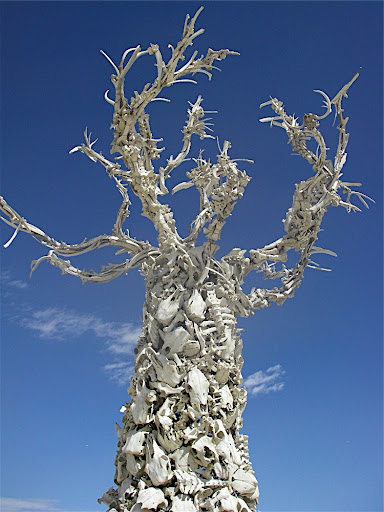
From under the Bone Tree we entered the pavilion, learning about at least an attempt at exploring the potential for green activism and engineering, and even though Burning Man itself has to be possibly the most un-green, abusive waste of gasoline I’ve ever witnessed, the waste is a logical exuberance of celebratory survival, and the pavilion was at least one step toward suggesting another way. Somehow this reconciled in my mind, because if there was one tenet that had planted itself in my head ever since arriving on the playa, it was that only vision has the power to transform reality. This was evident on the Man itself, which had been finally completed back atop its perch, the emblem of a phoenix branded on its face as a mark of its resurrection.
Though the weather soon became intermittently inclement, I had managed to grab my bike and witness the beginning of critical tits, a parade of thousands of topless women proud of their breasts. Interestingly, as one who’s always been a breast man, I was less turned on than I was inspired by the confidence and empowerment against the cages of modesty.
Soon the trail of nudists moved on, and I was determined to see one statue before its scheduled destruction. Huffing over near 2:00, I gazed at five metallic worshippers. One mohawked man sat in the lotus position with his hands to his heart, figures bowed and several iron women gasped and clasped their hands above their heads in reverence to that which was before them, a 90-foot oil derrick. The symbolism was simple, and it challenged me. It challenged all of us, and the very fuel of the Burn itself. I could not look away.

Finally the strong winds mutated into harpy dust tornadoes tearing about the playa, churning from the dry lakebed to a sea of evaporated water and dust above. White tsunamis crested from nowhere and blinded us from seeing three feet, caking alkaline microns into our skin that only vinegar would remove. Later I heard the story of one girl who became disoriented in the whiteout, and wandered about until she found a Ranger. “Fuck!” she told him, “Am I glad to see you! Do you know where center camp is?” And the Ranger pointed over his shoulder and said, “it’s twelve feet that way.”
But I had my bandanna and my goggles and I wasn’t about to let a little dust keep me from my trip. I hopped on my bike and rode out to the Deep End again. Only this time, instead of a magnificent sunset, the world was coated in ash. Not that it mattered. The Deep End was packed, partiers all there with the same coconut shavings of dust smeared over tinted UV-lenses, bandannas and dust masks tied tightly across their faces. The vibe was fierce, an epic battle against the elements that raged around us like the throbbing of bass and boots pounding against clay. A primal perseverance whirred from the crowd like generator electricity caught in a cable array ripping apart a rushing river of electrons.
Eventually it became too much for me, though when I left, the Deep End was still explosive, refusing to die. I spent a bit of time in the Paddy Mirage again to escape the worst of the storm, but then was back across the playa again, soon back at camp as the whiteout blew over. Then, suddenly, drizzles of drops plummeted, practically evaporating before they sizzled on the hot ground. We barely had time to jump out from our shelters and spread our arms welcoming the rain. But when we did, the sky cleared to reveal a colossal rainbow arching across the clouds--and then another one straddling its twin. We stood as tall as ants, peering up at these twin rainbows, this omen of Mother Earth once sent to Noah in cycles of fury and welcoming bosom. For a brief, fleeting moment everyone on the playa held their head high, humbled by rays of diffracting light.
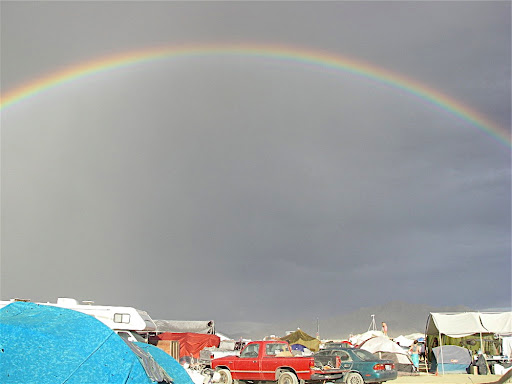
Friday night was fun too, riding Cloud Nine out to Root Society, checkin’ out Rabbit in the Moon over at Opulent Temple and letting Freq Nasty bring in the new dawn. But the rest of the week was prologue to the day that that dawn started – the day of the Burn. No really, for real this time.
The day was hot again, but by now I was used to the extreme heat, the pervasive sweat stagnating in this city of ambient ever-present dust. To pass the day, Pan and Tonka graciously invited me over to the airport around high noon. We biked out behind Black Rock City across a flat and dusty expanse of playa, where they showed me around the tiny air traffic control center. Pan showed me simple memorial, impressing upon me the sadness afflicting the community for the loss of one of the greatest burner pilots, Berk, who died in Idaho as I’m sure every hardcore burner dreams of dying, in a three-hundred-mile-an-hour fireball detonating into pristine mountains. Pan, intensely emotional, was insistent that I knew that this man, whatever his flying acumen, was responsible for more gifted flights in 2006 than all other burner pilots combined. Truly, it is an enlightened society that judges a man well for his selflessness.
They also introduced me to the air traffic commander, Hoot. Now, I don’t know if they call him that because of his keen eyesight, his nocturnal nature, or his constant humor, but I found the man both hysterical and genuine, ready to please a complete stranger, filled with stories of near misses and aeronautic mishaps and mile high clubs. Out on the airfield sat reconstructed Russian biplanes and World-War II style prop planes next to the latest and greatest in single-person jet screamers. Over 150 planes had been registered for the Green Man, a significant increase from the year prior, further proof of the explosive growth of the burn.
Saturday night, on the other hand, was dense.
The most tightly packed, in fact, I had ever seen such a chaotic gathering of people. Around the man they gathered, pink flamingos and fire spinners and metal rhinoceros and elephant artcars, double busses sporting DJs, and thousands upon thousands of glowstick-wearing, fur-sportin’ lunatics babbling in tongues and jitterbugging in caffeine and cocaine and speed, their skulls disintegrating, their neuroganglia spilling out all over cold lakebed in anticipation. Right on playa-time, the fireworks started. There had been ad hoc rockets blasting in the atmosphere all week, but now the explosions really began, sparkling in the hundreds against the stars. And suddenly, they stopped. The Man glowed neon Green for one second more, before a plume of fire immolated him, roaring up in a gurgling feast of gasoline. He burned and burned, and when he fell, the masses rushed in, trampling each other in violent passion to caress the scalding wood and metal, to unify themselves with the fallen spirit of Burning Man. Distinctly unsynergistically, I stood back and watched, basking in revelation.

All week I had been thinking about the nature of the burn, how at its core it’s a celebration of both creation and destruction, of alpha and omega. We revel in our survival against the harshest of climes, ascending an arduous path in the face of fierceness. But this fierceness is surrounded by art, music, psychotropic insight and beautiful friends, and is an awe-inspiring celebration, a mystic dance that untangles the path before us. We celebrate in tribes, chained by organization to have the freedom to get beyond constant survival tasks, to bask in creation and illuminate ourselves in immediacy. But though the burning of the Man can be interpreted in a thousand ways, it said to me that the immolation, the destruction, of the stationary body, even the active participant with his arms raised, is necessary for growth. As many have observed before, death yields evolution. In this case, it is an evolution of the spirit, a growth spurt for the purity of society as we search, unsure of our identity in the turbulent adolescence of our species.
Indeed, it is those who are willing to look the inevitability of death in the face, those who peer into the existential mirror of mortality with unapologetic fatalism who will shape the future landscape of the underground. Whether in the past it was the devotees of Dyonisus, the revolutionary Buddhists chanting in the face of castes, the occultists summoning demons at the peak of the industrial revolution, the beats, hippies, punks, ravers or burners, each underground must seek the figurative pyre to find themselves. Only those with nothing to lose, or at least, who recognize the illusion of everything we seem forced, against our better judgment, to gain, are willing to tear it all apart, to sear the flesh, to burn the body and release the spirit by whatever means necessary.
All week I had wondered: where is that line, where the worship of the self becomes less important than that of society? Where do orderly and chaotic ego synergy dissolve? Here, in wake of the Burning Man, I had two answers.
1) One interpretation: death. Our human nature dictates that in our destruction our isolated exuberance is diluted with concern for the community. It is through our community, through our children and our impact on society that we achieve some modicum of immortality. Is such genetic and memetic ingenuity not amazing? Only in a universe of utter abundance can such immortality be achieved for rotting flesh. In building our ephemeral Black Rock City, distilling into focus and then disintegrating in a matter of days, we both embrace our wandering souls of expression and also recognize the need for something greater, for a memetic ocean of humanity, a metahuman archetype of Jungian proportions.
2) Another interpretation: the Esplanade. Both Black Rock City and the deep playa are synergistic in nature, but it can be argued that BRC is inherently orderly, with its clockwork streets, its ice vending, its gifting economy, its Ranger station, its airport. For fuck’s sake, it even has a central decision-making system in center camp, the quintessential sign of sociological organization. But the playa…the playa. Art placed at random, tree houses near satellites adjacent to metallic giants with exploding heads, crisscrossed by art cars, bikers, footpads obeying no lanes. All radiate from the Man, but in no set pattern, the only organization the burner’s path under the constantly shifting sun and moon. What a sensation it was, and will continue to be, to stand at the edge of the Esplanade, that narrow strip of middle ground between growing organization and exploding randomness. What a feeling it is to contemplate its interwoven spiral, hinting that all distinctions between order and chaos, individualism and synergy are but illusions, artifacts of neural nets and dualistic thinking camouflaging the truth of evolution.
On we walked. And I wondered, perhaps ego synergy evolved in the tribal history of humanity as a lens to multiply and focus our innate holiness on a massive scale, thus enhancing the inspiration and connection resulting from spiritual meditation. And if so, perhaps chaotic ego synergy was more ancient than orderly synergy, more resonant with our primate instincts that ruled social structures at the dawn of man.
But my philosophizing was cut short for the night’s main event. Pan, Tonka, myself, Sitari, Shirley and two of Sitari’s friends came to the oil derrick and parked ourselves hundreds of feet away to witness fireworks spewing, tearing apart the night sky in weaving, sweeping artillery conflagration. Thousands of rounds exploded in golden phosphorescent shells that wove a net of light. I could describe it, but not my awe, not the sparks that filled my spine as the sky ignited. Just go on YouTube, or transport yourself back in time (it’s just like walking backwards, only four-dimensionally). A pillar of fire exploded into a mushroom cloud, consuming the derrick, leaping up to the cloud line. We watched, mesmerized. Gasoline pumped along the wooden derrick and fueled the intense flame, eventually disintegrating the base and bringing the structure crashing down.
What then of the “burniers”? What fate is in store for those that would deprive the scene of its change, growth, evolution? What of Paul Addis, the arsonist who tried to maim a vibrant underground and underestimated its internal treasury of symbolism? For you, Addis, I’m so very sorry the world cannot remain as small as it once was. I’m sorry that you have to share an incredible life changing experience with more people, and have an even greater world impact. I have only pity for you, for you are a mother hen, fretting when your chicks leave the nest and learn to fly. Go hide in isolation, by all means, never bask in the gleaming heaven of ego synergy or experience spiritual growth beyond conditioned prisons masquerading as unbending ideals.
Those willing to look in the mystic mirror cannot deny we stand at a crossroads of humanity. Our global population grows exponentially, draining resources. We still battle amongst each other as tribes, letting nationalism interfere with common human goals. Unlike Burning Man, our world does not have the option to cap ticket sales (or if it does, that is a topic for a future polemic). Thus, we must adapt, we must consciously and systematically redefine and implement our values if we are able to survive as a species. More thought must be devoted to this, but for now suffice to say that Burning Man can be a microcosmic experiment, if we choose it to be, an ephemeral diorama of how human society, at its heart, wants to function. If we learn from it, adapt to the evolving nature of the Burn, perhaps we can expand that knowledge to our world so that future generations practice rampant selfless expression instead of the egotistic avarice.
So let the biggest ups, the most love and respect be had for hardened, crusty burners teaching virgins the ways of the playa, showing them this new frontier with open hearts. For such growth, though painful, can only lead to the transfer of memory and energy beyond the body, and grant immortality of the spirit.
A few of us converged with the larger crowd at El Cirqo to witness the man, the myth, Bassnectar, mashing samples, bashing bass, tweaking pitch, seeking newness in every tempo, in every shift between flipping switches and fader pedals. Everything from 80’s beat to hard metal to drum & bass was woven together, a synergy of genres that formed a new identity of sound. It was music without borders, beat without labels or pretension, only utter hard shagging of eardrums and rampant burner joy.
Later, as his set faded into that of Antennae and Freq Nasty rounded out the night, I stepped out onto the playa, the beats to my back. At peace, I practiced my tai chi, watching as the statues that previously prayed to fossil fuels now surrendered to the black mountain and the majesty of the rising sun warming their metal bellies. That silver Sphinx artcar was there, eyes blinking blue and green. Any familiar with my previous blogging know the significance of the Sphinx as a personal symbol for the quintessence of Tao. It stood there, judging me, judging us. All I know is that it found us worthy. Of what, I’m not sure. This kind of truth takes its own time to be revealed.
Sunday was a chill day, sleeping, eating pancakes to Wilson Phillips, striking our sapphire bar. But as night fell, we saddled up Cloud Nine one last time to travel to the Temple. Sitari and I got close to the fire barrier and sat, feasting on the last visuals of the shrine as a soprano sang arias of “Somewhere Over The Rainbow” and then “Redemption Song.” A procession of torchbearers brought the death pyre to this Temple of holy forgiveness. Tens of thousands sat, unflinching, as a flaming beam was placed in their soul center. Soon ivory wood was engulfed, the surfaces of the narrow perpendicular beams black against white licking flame. Heat scorched the playa, raising the wind profile, kicking up dust. But nobody moved. Virtually all were seated, meditative. As the Temple continued to burn and burn, a kite ghost of the Burning Man flew overhead, lifted by fiery winds. Though the body had melted, the spirit remained. I found nothing but answers, and though I knew that more questions would inevitably arise, I did not fear them. One disembodied female voice suddenly split the silence. “We are so blessed!” she sang.
And the Temple toppled, pouring to the ground.

A singular peace had encapsulated the spirits of the Burn. From the silence, a shrieking voice cried out, but this was not the isolated voice of one individual. It was the cry of a synergistic ego, a massive ring of bodies acting with one mind, our shrill voice circling round and round the central burning detritus that was once whole and remained holy. It was the voice of a metaorganism, a primal portal into our future.
At dawn we left, braving exodus, the sierras, mediocre Chinese food and too many hours of driving to return to our modern megalopolis. It chafed, this structure, this illusion of permanence after so many hours of freedom. But it also glowed from underneath, and everything was connected. If this is what it takes to transform, to see ourselves for the men and women of divine choice and creativity that we are, then I say set fire to every sense of permanence. Do no damage, harm no individuals unwilling to participate. Let the eternal fire burn internally eternally, and let it burn from the center of each of us.
Let us sleep on down pillows and eat omakasa sushi and drink dirty martinis from crystal goblets and spill out in Jacuzzis and recline in box seats and relish every minute of our obnoxiously wonderful and luxurious lives as if we had just departed from the playa. Let us make every moment the object of our worship. Let us pursue hedonism not for the illusion of material possession, but truly for sensation itself as our playa-selves lather in prismatic immediacy and wonder.
If we can do that, if we can become conscious of what is true and what is truly illusion, then maybe, just maybe, one day we’ll have the courage to burn it all and rebuild our selves like a phoenix from the ashes.
I can’t wait to bathe in vinegar.

No comments:
Post a Comment